HUMAN RIGHTS
What are human rights?
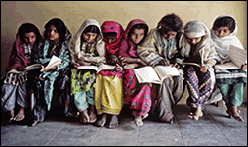 Human rights are rights we have simply because we exist as human beings - they are not granted by any state. These universal rights are inherent to us all, regardless of nationality, sex, national or ethnic origin, color, religion, language, or any other status. They range from the most fundamental - the right to life - to those that make life worth living, such as the rights to food, education, work, health, and liberty.
The Universal Declaration of Human Rights (UDHR), adopted by the UN General Assembly in 1948, was the first legal document to set out the fundamental human rights to be universally protected. The UDHR, which turned 70 in 2018, continues to be the foundation of all international human rights law. Its 30 articles provide the principles and building blocks of current and future human rights conventions, treaties, and other legal instruments.
The UDHR, together with the 2 covenants - the International Covenant for Civil and Political Rights, and the International Covenant for Economic, Social, and Cultural Rights - make up the International Bill of Rights.
Universal and inalienable
The principle of universality of human rights is the cornerstone of international human rights law. This means that we are all equally entitled to our human rights. This principle, as first emphasized in the UDHR, is repeated in many international human rights conventions, declarations, and resolutions.
Human rights are inalienable. They should not be taken away, except in specific situations and according to due process. For example, the right to liberty may be restricted if a person is found guilty of a crime by a court of law.
Indivisible and interdependent
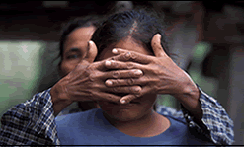 All human rights are indivisible and interdependent. This means that one set of rights cannot be enjoyed fully without the other. For example, making progress in civil and political rights makes it easier to exercise economic, social, and cultural rights. Similarly, violating economic, social, and cultural rights can negatively affect many other rights.
Equal and non-discriminatory
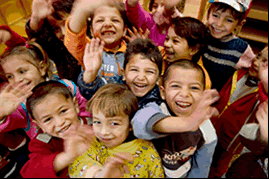 Article 1 of the UDHR states: "All human beings are born free and equal in dignity and rights." Freedom from discrimination, set out in Article 2, is what ensures this equality.
Non-discrimination cuts across all international human rights law. This principle is present in all major human rights treaties. It also provides the central theme of 2 core instruments: the International Convention on the Elimination of All Forms of Racial Discrimination, and the Convention on the Elimination of All Forms of Discrimination against Women.
Both rights and obligations
All States have ratified at least 1 of the 9 core human rights treaties, as well as 1 of the 9 optional protocols. 80% of States have ratified 4 or more. This means that States have obligations and duties under international law to respect, protect and fulfill human rights.
- The obligation to respect means that States must refrain from interfering with or curtailing the enjoyment of human rights.
- The obligation to protect requires States to protect individuals and groups against human rights abuses.
- The obligation to fulfill means that States must take positive action to facilitate the enjoyment of basic human rights.
Meanwhile, as individuals, while we are entitled to our human rights - but, we should also respect and stand up for the human rights of others.
Human Rights Bodies
The Office of the High Commissioner for Human Rights (OHCHR) works to offer the best expertise and support to the different human rights monitoring mechanisms in the United Nations system: UN Charter-based bodies, including the Human Rights Council, and bodies created under the international human rights treaties and made up of independent experts mandated to monitor State parties' compliance with their treaty obligations. Most of these bodies receive secretariat support from the Human Rights Council and Treaties Division of the Office of the High Commissioner for Human Rights (OHCHR).
Charter-based bodies |
Treaty-based bodies There are ten human rights treaty bodies that monitor the implementation of the core international human rights treaties:
|
Charter-based bodies

Charter bodies include the former Commission on Human Rights, the Human Rights Council, and Special Procedures. The Human Rights Council, which replaced the Commission on Human Rights, held its first meeting on 19 June 2006. This intergovernmental body, which meets in Geneva 10 weeks a year, is composed of 47 elected United Nations Member States who serve for an initial period of 3 years and cannot be elected for more than two consecutive terms. The Human Rights Council is a forum empowered to prevent abuses, inequity, and discrimination, protect the most vulnerable, and expose perpetrators.
The Human Rights Council is a separate entity from OHCHR. This distinction originates from the separate mandates they were given by the General Assembly. Nevertheless, OHCHR provides substantive support for the meetings of the Human Rights Council and follow-up to the Council's deliberations.
Special Procedures is the general name given to the mechanisms established by the Commission on Human Rights and assumed by the Human Rights Council to address either specific country situations or thematic issues in all parts of the world. Special Procedures are either an individual -a special rapporteur or independent expert-or a working group. They are prominent, independent experts working on a voluntary basis, appointed by the Human Rights Council.
Special Procedures' mandates usually call on mandate-holders to examine, monitor, advise and publicly report on human rights situations in specific countries or territories, known as country mandates, or on human rights issues of particular concern worldwide, known as thematic mandates. All report to the Human Rights Council on their findings and recommendations, and many also report to the General Assembly. They are sometimes the only mechanism that will alert the international community to certain human rights issues, as they can address situations in all parts of the world without the requirement for countries to have had ratified a human rights instrument.
As of 1 August 2017, there are 44 thematic mandates and 12 country mandates.
OHCHR supports the work of rapporteurs, independent experts, and working groups through its Special Procedures Branch (SPB) which services all but one of the thematic mandates and provides centralized support to the Special Procedures as a system. The Field Operations and Technical Cooperation Division (FOTCD) supports the work of country mandates.
Treaty-based bodies
There are nine core international human rights treaties, the most recent one -- on enforced disappearance -- entered into force on 23 December 2010. Since the adoption of the Universal Declaration of Human Rights in 1948, all UN Member States have ratified at least one core international human rights treaty, and 80 percent have ratified four or more.
There are currently ten human rights treaty bodies, which are committees of independent experts. Nine of these treaty bodies monitor implementation of the core international human rights treaties while the tenth treaty body, the Subcommittee on Prevention of Torture, established under the Optional Protocol to the Convention against Torture, monitors places of detention in States parties to the Optional Protocol.
The treaty bodies are created in accordance with the provisions of the treaty that they monitor. OHCHR supports the work of treaty bodies and assists them in harmonizing their working methods and reporting requirements through their secretariats.
There are other United Nations bodies and entities involved in the promotion and protection of human rights

Well written💯❤️
ReplyDeleteGrt work 💯
ReplyDeleteNice work! I’m no longer the woman i was bless you
ReplyDeleteReally well written. 😊
ReplyDeleteVery very informative.
ReplyDeleteWell written.
Great work!!
ReplyDeleteWell written 👍✔
ReplyDeleteGreat work
ReplyDeleteVry well written 💯 Keep it up ✨
ReplyDelete